
Reading scripture in light of the interpretation of the Early Church Fathers, and in light of the ancient Christian spiritual tradition handed on in the Church, brings out so much meaning. Including in 1 Kings 19, where in the beginning Elijah flees the murderous wrath of Jezebel, and in the end encounters the still, small voice of God. A rich example of patristic and spiritual interpretation that has very personal meaning for our lives.
Scripture reading early in the morning is so beautiful, foundational to my prayer practice for a very long time, nearly 30 years now. And it is inexhaustible. No matter how many times I read it – and I practice cover-to-cover reading, as I was taught as a new Christian in the Evangelical world – I still discover new meaning in it. It is truly inspired by the Holy Spirit and permeated with the infinite Mind of Christ, inside the clothing of human words, as Christ was clothed with human flesh.
Now an Orthodox Christian, I have good bible software that includes several collections and translations of Early Church Fathers that makes it easy to read scripture in light of their interpretation. It’s very helpful. Combined with so many years studying and putting into practice the ancient Christian teaching on prayer and spirituality East and West, it is very easy to see all kinds of spiritual meaning in the teachings of the bible.
For example, the other day I came to 1 Kings 19, where Jezebel threatens to kill Elijah. This is because in the previous chapter, he’d defeated her 800 false prophets with the power of God and had them killed.
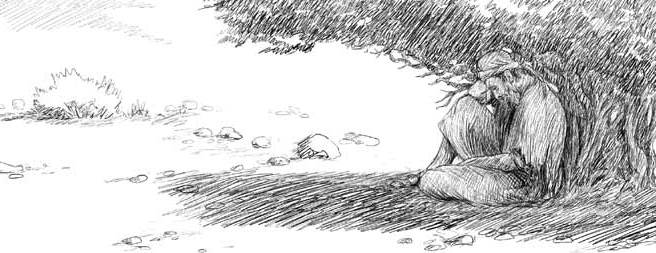
In the face of her threats Elijah, though immediately in the aftermath of such a great demonstration of power, was afraid and ran away. Went into the desert and hid under a tree.
And it occurred to me for the first time, how could it be that he, one of the greatest prophets of the Old Testament, was so afraid?
I looked up the passage in my bible software to see what the Fathers might have to say about it, came across commentary from three Fathers: St. Jerome, St. Ephrem the Syrian, and St. Ambrose of Milan, all of the fourth century (Jerome lived into the fifth).
St. Jerome: Confession and Interior Healing
St. Jerome, whom we know from the historical record was temperamentally acerbic and prone to public argument and controversy (for which his friends at times rebuked him), in Against the Pelagians (2.21) says Elijah’s fear is bad, because proceeding from a disturbance of the soul. There is truth to this, given the many biblical admonishments not to be afraid, in both Old and New Testaments and from Jesus Himself.
Truth to it in light of the Orthodox emphasis on healing the interior passions of the soul, something unique to Orthodoxy compared to other kinds of Christianity. We need to be interiorly healed so we are interiorly at peace, no longer disturbed by unruly passions, thus more able to attain interior union with God.
For example, comparing the Catholic and Orthodox approaches to confession, in which both believe real grace is given to cleanse one of sin. In Catholicism you only confess sinful external actions, sins you’ve actually committed, as sinful feelings, thoughts or temptations are not considered sins so long as you haven’t acted on them (and unfortunately, for many Catholics confession can become just a rattling off of a list of sins, rather than a discussion of deeper interior struggles).
But in Orthodoxy, it is very important to confess all sinful feelings, thoughts, and temptations along with actions, whether we act on them or not, a practice originating in the very early Church. This is how healing grace penetrates into the heart so it can be healed. As Jesus says, sin originates in the heart before it proceeds into action, so the heart needs to be cleansed if it is to be a fit dwelling place for God. Otherwise we are, as He says, like dead men’s tombs, white-washed on the outside but interiorly still filthy.
I believe this difference in approach is critically important, that Catholics are being cheated of a great amount of grace and spiritual development by being told to only confess actions, not the interior states that lead to the actions (could be one explanation for many of the problems in the Catholic Church, though not the only). Searching myself and confessing what is really going on inside of me to a trusted priest, whether I’ve acted on it or not, is very powerful and does lead to real interior change, something I intuitively felt long before I encountered Orthodoxy. And even while still Catholic was teaching Catholics to approach confession this way.
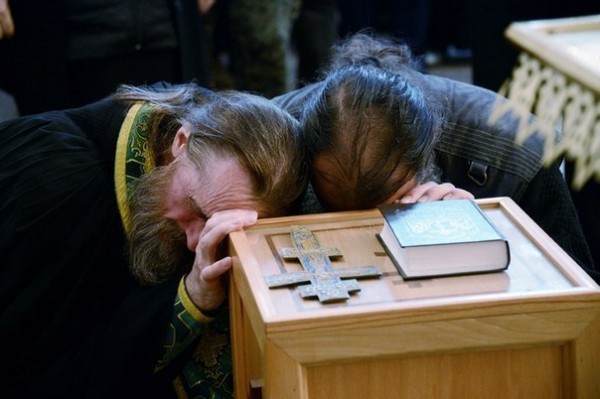
And teaching them to avoid priests who told them, as I was told many times, “Well, you haven’t actually sinned, so I can’t absolve you.” What a cheat. We need to look for priests who support us in serious interior change, healing and purification, not turn us away. And thankfully, some can be found in the Catholic world, if you look. I drove a distance for years just to get to the few I did find – and they were a treasure to me. In the Orthodox world it is not a problem, all priests understand the need to discuss what is really going on inside a person, experience of confession far more relational and healing.
St. Ambrose and St. Ephrem: Wisdom and Holy Fear
St. Ambrose and St. Ephrem have a different point of view compared to St. Jerome. St. Ambrose was a strong but balanced and compassionate personality, St. Ephrem a man of deep heart and a great poet of Syria (in accord with the Syriac tradition expressing theology as poetry). They both say it is good that Elijah fled, for several reasons.
For St. Ambrose, Elijah was not fleeing Jezebel, but rather the world. Nor did he fear death, for once under the tree he asked the Lord to take him (1 Kings 19:4). Rather he was weary of the world, in Ambrose’ words “…fleeing worldly enticement and the contagion of filthy conduct and the impious acts of an unholy and sinful generation” (Flight from the World, 6.34).
For St. Ephrem, in his commentary On the First Book of Kings (19.3), it was out of wisdom Elijah fled, because there was no reason for him to die, and it would have made it appear he had been defeated and killed by the false gods of the queen. Killed by Baal, the chief and worst of the false gods, the one to whom in the Old Testament infant sacrifice was offered (which we know to be true, the remains of infant sacrifice having been found in archeological digs in Israel and the Middle East).
Elijah wasn’t the only one in the bible who fled. David fled many times, keeping away from murderous Saul until able to become King of Israel. Mary and Joseph fled when Jesus was a baby, to protect Him from Herod’s wrath, and Jesus Himself withdrew and moved around constantly, keeping away from the murderous priests and Pharisees until the right time had come for His death, which He chose and used for good.
Christians fled during persecutions in the early church, hid in catacombs, moved elsewhere – or, if captured, faced death bravely rather than renounce Christ. As has happened in the modern world, for example the Communist Revolution in Russia and Eastern Europe during which millions of Orthodox Christians were killed, and those who could fled to safer countries.
So all three Fathers, Jerome, Ambrose and Ephrem, offer important insights. As Jerome says, we should not be afraid in a worldly way, should work to purify our souls of disordered worldly fear. As Ambrose and Ephrem say, there is a kind of healthy fear that gives us courage and wisdom, what in the spiritual tradition is called holy or godly fear. It is born of great love for God, includes fleeing from sin so as not to get caught up in it, fleeing to save your life so you can continue to do good, accepting death to glorify God if it is unavoidable, and even asking the Lord to take us, if it is to escape the evil in the world and be with Him.
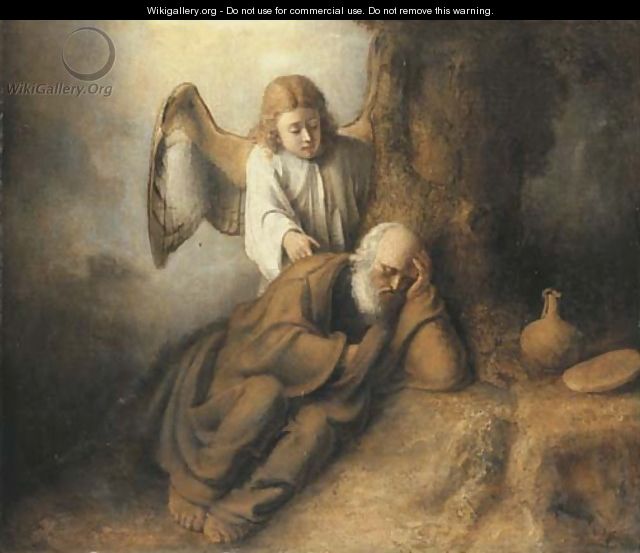
Elijah does ask God to take him, but God instead feeds and strengthens him through the ministry of an angel. It was not Elijah’s time to leave this world, he still had work to do. On the strength of that meal he travelled 40 days and 40 nights, until he came to a mountain and went into a cave, leading to the great scene where God passes close by him, and he hears the gentle voice of God.
Purification so as to Bear the Presence of God
As I meditated on these passages, other thoughts ran through my mind, inspired by more teachings found in traditional spiritual theology.
After his confrontation with the 800 evil prophets, putting them to death, Elijah was spiritually exhausted, drained, emptied out. There is such a thing as spiritual exhaustion, I’ve experienced it in the aftermath of work I’ve done in the Church. But we can also spiritually refill ourselves and be renewed, if we turn to God as Elijah did.
Elijah was an honest man and knew his own limitations, why he ran, lay down under a tree, poured out his heart to God and fell asleep. We should all be so honest, unafraid of admitting our weakness, but trusting in God and committing ourselves to Him, as Elijah did before falling asleep – as Jesus did from the Cross, entrusting Himself to His Father.
And God responded, sending the angel to give him bread and water, a prefiguration of the Eucharist (bread changed into the Flesh of Christ; water into wine at the wedding of Cana and then into the Blood of Christ), a divine gift of food which strengthened him for his 40-day journey.
And it was given while he was under a broom tree, a type that has deep roots and spreading branches, a place of shade and rest. Reminiscent of the wise man of Psalm 1 who avoids the wicked, who is like a tree planted by streams of water such that he never withers, but bears much fruit, as Elijah also would do.
At the end of his 40-day journey he came to a cave and spent the night, caves in the bible and in spiritual theology representing deep prayer, darkness of faith, contemplation, purification, encounter with God. Jesus was born in a cave that served as a stable, where people first encountered the living God in human form.
God came to Elijah in the cave, and Elijah honestly expressed his upset with unfaithful Israel, and his feeling of complete isolation and loneliness, feeling he was the only prophet left. And God told him to go outside, as He was going to draw near. God’s power manifested first in a great wind, then an earthquake, and then a fire. But God was not in any of these things, only, in the end, a still, small voice (1 Kings 19:12).

In the spiritual life, aided by sacraments, prayer, asceticism, there are stages of spiritual purification and growth, so one can in time encounter and experience union with God. It occurred to me that these manifestations of God’s power might represent a kind of purification of Elijah. The wind of the Holy Spirit, the earthquake of the outpouring divine life that happened from the Cross, shaking the earth, tearing the curtain in the Temple and raising the dead. The fire of the light of God, unbearable in an unpurified state, but growing gentler, cooler, more bearable as purification and holiness progress.
In the end a still, small voice, a gentle whisper, only heard by a purified, stilled, silent soul, what the Orthodox call hesychia: the prayerful practice of stillness and silence, as the heart implores, Lord Jesus Christ, Son of God, have mercy on me, a sinner… so similar to Elijah’s cry to God.
But needing to cloak his face in the presence of God, because grace had not yet been outpoured, the veil of sin not yet removed. And needing darkness of faith and modest humility in the presence of God, not a bold stare. The humble tax collector, not the self-righteous Pharisee.
He again expressed himself to God, and God, now being very near to him, answered with instructions and consolation. Let him know that he was not the only one, there were 7000 other faithful souls still in Israel, and He would raise up another prophet for him, Elisha, who would work with him and follow in his footsteps.
Elijah, though a great prophet who had witnessed the power of God, knew his limits, acted wisely, and was a humble man who admitted his faults and fears to God. And God responded, drew near to him, provided for him, strengthened and supplied for him. So He will for us, if we are honest with God as Elijah was.
What a rich meditation on a single chapter of scripture, so many thoughts and insights flowing through my mind in the divinely inspired scriptures, aided by the insights of the Fathers of the Church and their teachings handed on in the spiritual theology of the Church.
At the end I turned to see which psalm I needed to read next. Very fittingly, it was the beautiful Psalm 33 (34 in Protestant bibles), about the protection and providence of God:
I sought the Lord, and He heard me,
And delivered me from all my fears.The angel of the Lord encamps all around those who fear Him,
Psalm 33 (34): 4, 7-8
And delivers them.
Oh, taste and see that the Lord is good;
Blessed is the man who trusts in Him!

 Wellsprings